What is a Medical Device Import License in India and Why Does It Matter for Your Business?
If you want to bring a medical device into the Indian market, the first thing you need to understand is the Medical Device Import License in india. This license is your legal permission to import and sell medical devices across the country.
It is issued under the Medical Device Rules 2017 by the Central Drugs Standard Control Organization (CDSCO). In simple terms, CDSCO checks that your device is safe, of good quality and traceable before it reaches hospitals, clinics or patients.
Whether you are dealing with a basic thermometer or a complex life-support device, this license is the entry gate to India’s fast-growing healthcare market. For foreign manufacturers and Indian investors, understanding this approval is the first smart step toward long-term success.
What Exactly Does the Medical Device Import License Cover?
The Medical Device Import License in india applies to all classes of devices defined under MDR 2017. These classes are based on risk levels from low to high.
- Class A – Low-risk devices, such as simple consumables
- Class B – Low to moderate risk, like some diagnostic products
- Class C – Moderate to high risk, such as many active devices
- Class D – High-risk devices, including critical life-support systems
No matter which class your product falls into, you must obtain an import license before shipping it into India for commercial use.
Why This License Is So Important
For investors and manufacturers, this license provides much more than just legal clearance.
- Legal market access – You avoid seizure, delays or penalties at Indian ports.
- Quality assurance – Your device is aligned with global standards like ISO 13485 for quality systems and ISO 14971 for risk management.
- Trust and reputation – Hospitals, doctors and distributors feel more confident dealing with a fully compliant product.
- Long-term stability – The license is perpetual, as long as you pay the retention fee every five years.
For Indian partners who plan to distribute or invest in medical technology, working only with licensed products helps build a strong, credible portfolio.
Key Documents You Need Before Applying
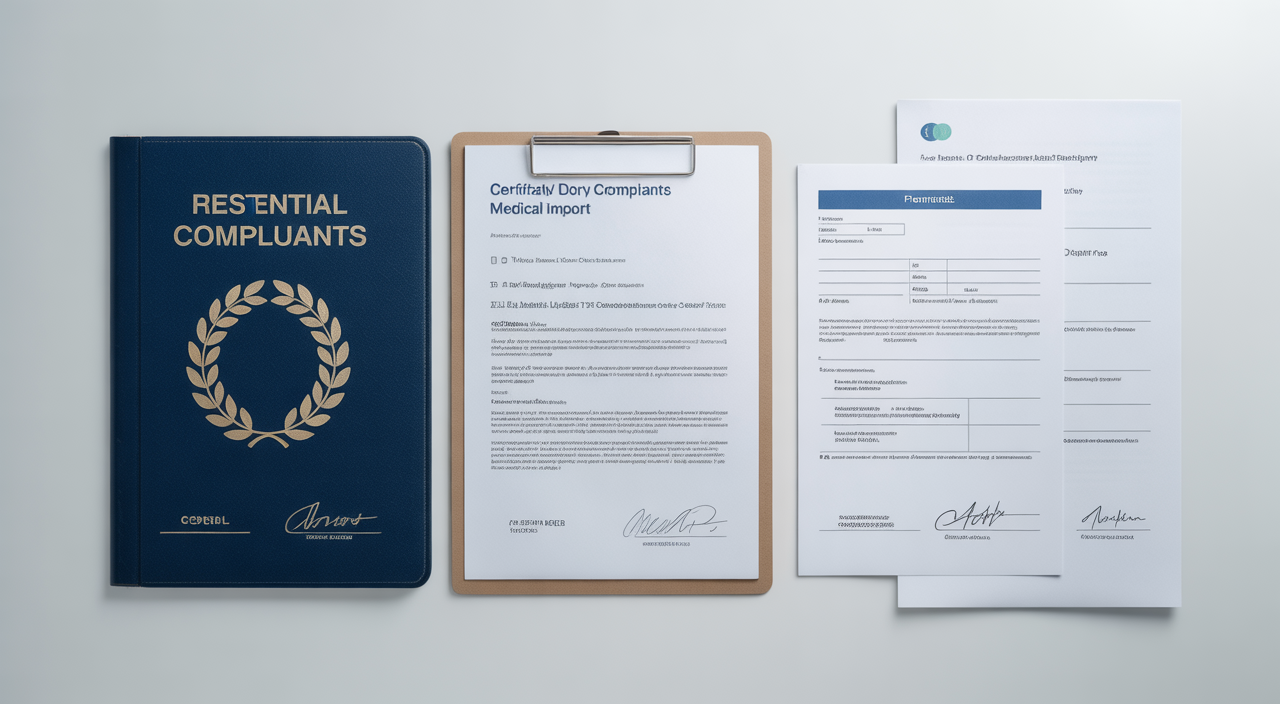
To get approval, you must submit a clear, complete set of documents through the online SUGAM portal. Here are the basics in simple terms.
Mandatory documents:
- Covering letter on the foreign manufacturer’s letterhead
- ISO 13485 certificate of the manufacturer’s quality management system
- Technical dossier of the device, including description, labeling and risk analysis as per ISO 14971
- Free Sale Certificate (FSC) or Certificate to Foreign Government (CFG) from the home country regulator
- Undertaking by the Authorized Indian Representative (AIR)
- Valid Drug Wholesale Licence of the AIR (Form 20B/21B or 20BB/21BB)
- Power of Attorney in favor of the AIR, signed and legalized as required
- Proof of device classification as per MDR 2017
Optional / as applicable:
- Test reports like biocompatibility, EMC or electrical safety test results (IEC 60601, IEC 62304 etc.)
- Post-market surveillance plan to track device performance after launch
- Clinical evaluation report, especially for higher-risk devices
Step-by-Step Procedure to Get Your License
The overall process is structured but manageable if you follow it carefully.
- Appoint an Authorized Indian Representative (AIR)
The AIR is your legal face in India. This person or company must hold a valid Drug Wholesale Licence. They will handle communication with CDSCO, support vigilance and manage post-market surveillance. - Classify your device correctly
Use MDR 2017 to identify whether your product is Class A, B, C or D. Correct classification is important because it affects the level of scrutiny and documentation required. - File Form MD-14 through the SUGAM portal
The AIR uploads all the required documents and fills the online application. It is important that file names, details and product descriptions are consistent throughout. - Respond to CDSCO queries
CDSCO may ask for clarifications or extra data. Quick and clear replies help keep your timeline on track. - Grant of License in Form MD-15
Once satisfied, CDSCO issues Form MD-15. This is the official import license. Timelines are usually 3 to 6 months, depending on device risk level and completeness of your dossier.
Common Mistakes You Should Avoid
A few small oversights can slow down your approval. Here are common issues seen in applications.
- Authorized Indian Representative does not have a valid Drug Wholesale Licence
- Technical dossier is incomplete or not aligned with ISO 14971 or other relevant standards
- Device classification mentioned in different documents is inconsistent
- Important international standards like IEC 60601 or IEC 62304 are not referenced for electrical or software-based devices
- Retention fee is missed after five years, putting the license at risk
Careful planning and professional support can help you avoid all these issues and move smoothly through the process.
What Happens If You Try to Import Without a License?
While the focus should stay positive and growth-oriented, it is useful to know the risks of skipping this requirement.
- Consignments can be stopped or seized at the port of entry
- Your existing license, if any, can be suspended or cancelled
- You may face monetary penalties and legal notices from regulators
- Your market reputation can suffer among distributors and healthcare providers
For serious investors, following the rules is always wiser than taking shortcuts. It protects both your finances and your brand.
Cost Overview for Planning and Budgeting
Costs vary by device type, number of models and service providers, but you can plan using broad ranges.
- Official CDSCO fees: around INR 10,000 to 50,000
- Professional consulting or regulatory charges: around INR 50,000 to 150,000, depending on complexity
- Retention fee every five years: around INR 10,000 to 20,000
When you compare these costs with the size of the Indian healthcare market and the license’s perpetual nature, the investment is usually very attractive, especially for scalable product lines.
How Expert Support Makes Life Easier
Regulatory work requires attention to detail. Many manufacturers and investors prefer to work with specialized consultants for gap analysis, dossier preparation and portal submissions. Expert support helps align your documentation with ISO and IEC standards and reduces the chance of delays.
If you are exploring broader international topics and policy perspectives that shape healthcare and trade, resources like this guide on the role of global institutions in international relations can also provide useful context for your long-term strategy.
For those diversifying into other regulated or technical sectors, it is also helpful to study how different industries manage quality and compliance, as seen in articles on leading industrial suppliers in India.
Conclusion
The Medical Device Import License in india is not just a regulatory requirement; it is your foundation for a sustainable, trustworthy business in a very promising market. By choosing a capable Authorized Indian Representative, preparing a complete and accurate dossier and staying aligned with MDR 2017, you can unlock strong growth opportunities.
For Indian investors, partnering only with fully licensed products and compliant manufacturers helps protect capital and build long-term value. With the right planning and expert guidance, the path to approval becomes clear, predictable and rewarding.
FAQs
Q1: How long does it usually take to get an import license?
Most applications are processed within 3 to 6 months. Higher-risk devices or incomplete documentation can extend this timeline, so it pays to submit a clean, well-prepared file.
Q2: Is the Medical Device Import License in India renewable like a normal license?
The license itself is perpetual, which means it does not expire on a fixed date. However, you must pay a retention fee every five years to keep it active and valid.
Q3: Do I always need an Authorized Indian Representative?
Yes. A foreign manufacturer cannot apply directly. An AIR with a valid Drug Wholesale Licence must handle the application and be the local point of contact for CDSCO.
Q4: Is ISO 13485 certification compulsory for the manufacturer?
Yes. ISO 13485 is mandatory because it proves that the manufacturer follows a recognized quality management system specific to medical devices.